
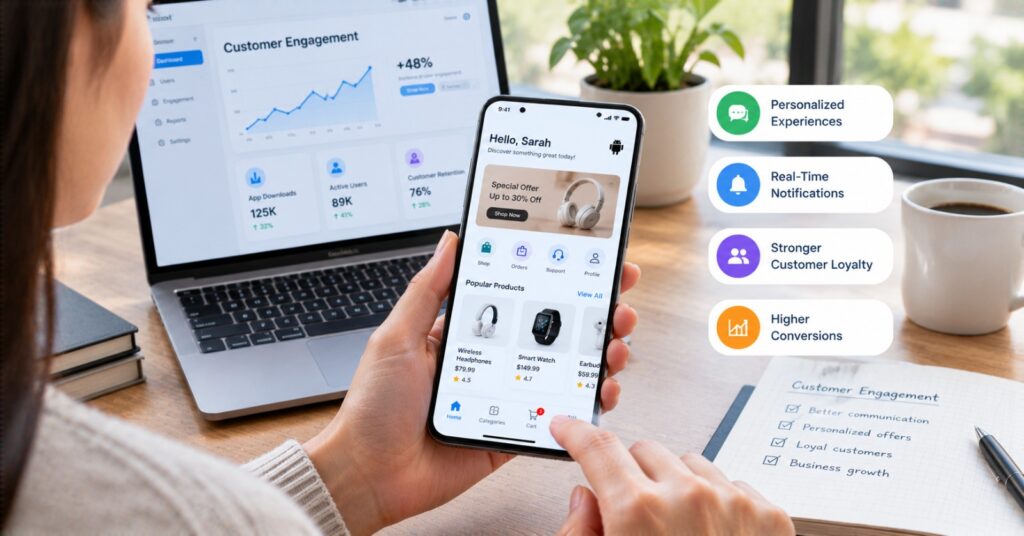
A coffee chain I read about had a loyalty program that technically worked and practically didn’t. The card-punch system had been in place for eleven years. About forty percent of transactions involved a loyalty card being presented. The remaining sixty percent were customers who’d either forgotten their card, lost it, or never bothered getting one. The chain knew their frequent buyers were worth significantly more than occasional buyers every loyalty program analysis shows this – but they had no reliable mechanism for identifying which customers were which, and no way to maintain contact with any of them between visits.
They launched an Android-first mobile loyalty app. Android-first because their customer demographic research showed their core customer – 25-to-45-year-old office workers in urban and suburban markets – skewed significantly toward Android across the income levels their pricing served. Within eighteen months, active app users were visiting nearly twice as frequently as non-app customers, spending measurably more per visit, and responding to targeted promotions at rates that the paper-based system’s broadcast approach had never approached.
The card hadn’t changed. The product hadn’t changed. What changed was the engagement infrastructure – the ability to identify individual customers, maintain contact with them between visits, understand their behavior well enough to communicate relevantly, and make the loyalty relationship feel like a relationship rather than a points accumulation exercise. A capable Android App Development company building for customer engagement understands that engagement is a fundamentally different problem from acquisition. Acquisition is about getting someone to try you once. Engagement is about making them choose you consistently, and that requires different tools built around different objectives.
What Engagement Actually Requires That Experience Doesn’t
Table of Contents
Customer experience and customer engagement are related but different problems, and conflating them produces apps that do one reasonably well and the other inadequately.
Customer experience is about the quality of specific interactions – the transaction, the service call, the browsing session. It’s episodic. It’s measured at moments. An app that makes each individual interaction better is improving customer experience.
Customer engagement is about the pattern of behavior over time – how often a customer returns, how deep their relationship with the brand runs, how likely they are to recommend the brand to others, how resilient that relationship is to competitive alternatives. It’s longitudinal. It’s measured across periods. An app that keeps customers coming back, that deepens their attachment to a brand, that makes them advocates rather than just users – that’s improving customer engagement.
The features that improve experience don’t automatically improve engagement. A beautifully designed checkout flow improves the experience of that transaction without necessarily giving the customer a reason to think about the brand between transactions. A fast, clear service recovery mechanism improves the experience of having a problem without necessarily deepening the customer’s commitment to the brand. Engagement requires mechanisms that operate in the spaces between transactions – touchpoints, motivations, social connections, and communications that maintain the customer relationship when there’s no immediate commercial reason for the customer to be thinking about the brand.
Push Notifications as an Engagement Mechanism
Push notifications are the most direct engagement mechanism available in Android apps, and they’re also the most commonly misused – trained into ineffectiveness by brands that treat the notification channel as a broadcast medium for promotions the customer didn’t request.
The distinction between notifications that engage and notifications that train disengagement is specific and consistent. Notifications that engage arrive at a relevant moment, contain information the recipient finds genuinely useful or timely, and require minimal action to capture value from. The coffee chain notification that arrives at 7:45am on a Tuesday because the customer typically buys coffee between 7:30 and 8:00am on weekdays and there’s a limited-time seasonal drink launching today – that notification is relevant, timely, and specific in a way that separates it from the generic promotional blast.
Android’s notification system has specific capabilities that matter for this precision. Notification channels allow customers to set preferences at a granular level – opting into order status notifications while opting out of promotional ones, for example – which gives customers control that reduces blanket opt-out rates. Rich notifications that include images, action buttons, and expanded content allow customers to capture value from the notification without requiring an app open, which reduces the friction between receiving a notification and acting on it. Scheduled notification delivery that respects time zones and device usage patterns produces notifications that arrive when customers are likely to be receptive rather than when the marketing team’s campaign scheduled them.
The brands that have built genuine notification engagement – not just high send volume but high value receipt – have invested in the customer behavior data required to make notifications relevant and in the permission management infrastructure that gives customers enough control to maintain a channel relationship rather than closing it off entirely.
Gamification That Works Beyond Week One
Gamification in engagement apps has a well-documented problem: the initial engagement spike and the subsequent plateau. Points, badges, streaks, and leaderboards generate genuine behavioral response when they’re new and lose much of their effect as they become familiar.
The gamification that sustains engagement over months rather than weeks shares characteristics that separate it from the surface-level implementation that produces the week-one spike without the lasting effect. The reward that’s variable rather than predictable – not “ten points per purchase” but “discovery of unexpected rewards that reflect the brand’s personality” – maintains attention in ways that predictable rewards don’t, because the behavior produces unpredictable positive outcomes that the psychological literature on variable reward schedules shows produce more persistent behavior change than fixed-ratio rewards.
Progress toward meaningful milestones – not just accumulating points toward a generic discount but progressing toward recognition, access, or experiences that carry status within the brand community – produces engagement that extends past the point where the monetary value of the reward is the primary motivation. The coffee app member who’s working toward an invitation to a coffee tasting event with the chain’s head roaster is motivated by something that a competitor’s points offer can’t easily displace, because the reward isn’t fungible.
Challenge mechanics that create time-bounded goals – complete five visits this month, try three new menu items this week – produce engagement bursts that can be strategically deployed to counteract the natural decay in engagement that all loyalty programs experience over time. The well-designed challenge that arrives when engagement data suggests a customer is starting to drift is doing active retention work that passive points accumulation doesn’t.
Social Features and Community That Deepen Commitment
The engagement level that produces brand advocacy – the customer who recommends enthusiastically rather than just returning personally – requires a social dimension that most loyalty apps underinvest in.
Social features in Android engagement apps work most effectively when they’re attached to genuine shared experience rather than competitive ranking. A leaderboard that shows which loyalty members have visited most often in the past month creates comparison that demotivates everyone who isn’t at the top. A social feature that shows which new menu items friends have tried and allows sharing of tasting notes creates shared discovery that deepens the experience of both people without requiring competitive framing.
Referral mechanics that reward both referrer and referred – structured as shared experience rather than transactional recruiting – produce higher quality referrals and higher referral conversion rates than those that feel like a sales pitch incentive. The customer who shares their coffee app membership because a friend gets to try the app’s exclusive menu discovery feature alongside them is making a social gesture rather than completing a transaction, which is how brand advocacy actually spreads.
The Testing Infrastructure Behind Consistent Engagement
Building an Android engagement app that works consistently across the full range of customers who use it requires testing infrastructure that matches the device diversity of the Android ecosystem.
Best Android Emulators – virtual device environments that simulate specific hardware and software configurations – are the most practical tool for testing engagement app behavior across the range of Android devices a broad customer base will bring to the app. The push notification that displays correctly and taps through cleanly on a Samsung Galaxy S24 may render differently on an older Motorola or a budget device from a manufacturer with a custom Android skin. The gamification animation that runs smoothly on a current flagship creates jank on a three-year-old mid-range device that a significant share of the customer base uses daily.
Testing engagement app behavior across emulated device profiles – combined with physical device testing on the most common devices in the target customer base – catches the experience degradation that produces silent disengagement. The customer who gets a poorly rendered notification, experiences a buggy rewards animation, or encounters a social sharing feature that doesn’t work on their specific device doesn’t file a bug report. They just open the app less, and eventually not at all, and the engagement metrics decline in ways that can be attributed to a dozen possible causes rather than the specific technical failure that caused them.
Content and Communication That Maintains Relevance
The engagement apps that maintain customer attention over the longest periods have developed content and communication strategies that give customers a reason to open the app independent of an immediate purchase intent.
The coffee chain that tells the story of where this month’s single-origin pour-over comes from, provides a behind-the-scenes look at how the seasonal menu was developed, or offers a limited brewing tutorial from the head barista is creating content that some customers will genuinely value and that positions the brand as a source of something beyond coffee. The customer who opens the app to read a coffee origin story isn’t opening it to buy something – they’re opening it because the app contains something they find interesting. That behavior pattern, repeated enough times, produces the habitual engagement that makes the brand genuinely present in the customer’s life.
The balance between commercial communication and non-commercial content matters significantly for this strategy. An app that delivers good content alongside commercial messaging maintains a relationship that customers find valuable. An app that delivers only promotional content, regardless of how well-targeted, is a marketing channel the customer tolerates rather than a relationship they choose to maintain.
What the Coffee Chain’s Engagement Data Showed
Eighteen months after launch, the chain’s analysis showed that active app users were not only visiting more frequently – they were significantly less price sensitive to competitive offers than non-app customers. A competitor’s promotion that moved non-app customers converted app-engaged customers at a much lower rate. The relationship that the app had built was doing genuine loyalty work – not just rewarding the behavior that was already happening, but creating a preference resilience that the card-punch system had never produced.
The engagement gap between app customers and non-app customers wasn’t explained entirely by selection effects – the customers most likely to download a loyalty app being the customers most likely to be loyal anyway. The chain’s analysis controlled for prior visit frequency and found that the engagement infrastructure itself was producing incremental loyalty beyond what the pre-existing customer behavior would have predicted.
That incremental loyalty – the additional visits, the reduced price sensitivity, the higher advocacy – represents the return on engagement investment. It doesn’t show up in the first month. It accumulates over the months and years that a sustained engagement relationship produces, compounding in ways that the point-in-time loyalty card never could.
That’s what building for engagement rather than experience produces, when it’s done well and given enough time to work.

