
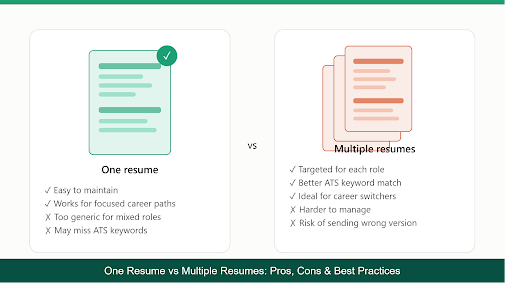
Most people fall into one of two camps with their resume. Either they’ve got one version they send to every job, hoping it’s generic enough to fit anywhere. Or they’ve got five different versions saved on their laptop, tweaked so many times they’ve lost track of which one actually works.
The real question behind one resume vs multiple resumes isn’t about picking a side. It’s about knowing which one actually fits your situation. Neither approach comes from a real strategy on its own; without that clarity, it’s just guesswork. And that guesswork is usually the reason good candidates get skipped over, not because they’re underqualified, but because their resume never made the case clearly enough for any single role.
When One Resume Actually Gets the Job Done
Table of Contents
If your career path has stayed on one lane, you probably don’t need more than one resume. The logic is simple: when your job title, your skills, and the roles you’re applying for all line up, there’s nothing left to customize. One clear, well-built resume already tells the full story.
A quick example
Think of someone who’s worked as an accountant for the past six years, applying for accountant roles at different companies. Their job title matches, their skills match, and the responsibilities they list are relevant every single time. Changing that resume for each application wouldn’t add anything. It would just mean redoing work that’s already working.
The same applies to teachers, engineers, nurses, or anyone whose experience points in one direction. One resume isn’t a shortcut here. It’s simply the right tool for a focused career path.
Where One Resume Starts Working Against You
The trouble starts when you use that same resume for roles that aren’t actually similar. If you’re applying to sales, admin, and customer service positions with one generic version, none of them get a strong pitch; the resume ends up speaking a little to everyone and a lot to no one.
Why recruiters skip past it
Recruiters and ATS systems are both scanning for one thing: a clear match to the job description. A resume built for multiple job types rarely has the specific skills or keywords that either one is looking for. It’s not that the candidate lacks experience. It’s that the resume doesn’t say where that experience actually fits, so it gets passed over before anyone reads the details.
When Multiple Resumes Actually Make Sense
If your experience doesn’t fit neatly into one lane, one resume won’t cover it. This is common for people switching careers, or anyone whose background overlaps across more than one function, say, someone who’s handled both sales and customer support.
Using multiple resumes here isn’t about changing your experience or making things up. It’s the same background, just presented with a different focus depending on the role.
Multiple resumes make sense when:
- You’re applying to more than one type of role
- Your past work covers overlapping skill sets
- You want your resume to match each job description more closely
- One version of your resume isn’t getting responses
Each resume should still be built around real experience, just highlighted differently depending on what the job actually needs.
How ATS Actually Reads Your Resume
Before a recruiter even opens your resume, most companies run it through an ATS software that scans for keywords matching the job description. If your resume doesn’t include the right terms, it can get filtered out before a person ever sees it.
This is why the same resume doesn’t always perform the same way twice. A resume built for one job description will naturally include different keywords than one built for another. Building a cv writing service ireland isn’t about stuffing in every possible skill. It’s about matching what the system and the recruiter behind it are actually looking for in that specific role.
A Simple Way to Figure Out What You Need
Instead of guessing, ask yourself a few honest questions:
- Am I applying to one type of role, or several different ones?
- Do my skills and past titles already match the jobs I want?
- Am I getting responses with my current resume, or mostly silence?
- Does my experience naturally split across more than one job function?
If most of your answers point to “one role, one direction,” a single resume is enough. If your answers vary, a second version built around your other skill set will likely perform better.
| Your Situation | What You Likely Need |
| Same role, different companies | One resume |
| Different roles, overlapping skills | Multiple resumes |
| Getting little to no response | A more targeted resume |
How Many Resumes Do You Actually Need?
When it comes to one resume vs multiple resumes, most people assume more versions mean more chances. But more resumes don’t mean more chances. They usually just mean more room for mistakes. In most cases, two or three well-built resumes are enough to cover different roles without losing track of which version says what.
Trying to maintain five or six versions often backfires. Details get mixed up, outdated experience slips into the wrong version, and keeping them all updated becomes its own job. A focused set of resumes, each built for a clear purpose, will always outperform a pile of half-updated ones.
A Few Resume Tips Worth Keeping in Mind
A Few Practical Pointers Before You Send It Off
Most resume writers canada tips come down to keeping things organized rather than reinventing your resume every time. Keep one master resume with your full work history, and build role-specific versions from it.
- Name each file clearly “Accountant_Resume” or “Sales_Resume” so you always send the right one
- Double-check each version before sending; leftover details from another role are an easy way to lose a shortlist
- Update your master resume first, then adjust the smaller versions to match
Frequently Asked Questions
Is it bad to have multiple resumes?
No, as long as each version reflects your real experience. Having multiple resumes only becomes a problem when the details start conflicting or you send the wrong version by mistake.
Should I use one resume for every job application?
Only if you’re applying to the same type of role consistently. If you’re targeting different job functions, a single resume usually can’t highlight the right skills for each one.
How many resumes should I actually have?
Two or three is typically enough for most job seekers. Anything beyond that becomes harder to manage and update accurately.
One resume vs multiple resumes, which is actually better?
Neither is universally better. One resume works when your roles are consistent; multiple resumes work when you’re targeting different job types. The right choice depends on your career path, not a fixed rule.
Is it dishonest to have different versions of my resume?
No. As long as the experience listed stays accurate, presenting it with a different focus for different roles isn’t dishonest. It’s simply relevant framing.
The Real Takeaway
The real battle isn’t one resume vs multiple resumes. What matters is whether each one has a clear job in mind, the right title, the right skills, and the right focus. Get that part right, and the number of versions stops being the issue. Your resume just starts doing what it’s supposed to: getting you the interview.

