
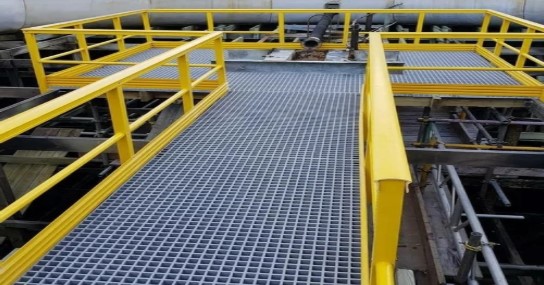
Slip-resistant and maintenance-free walkways made of FRP are pushing the boundaries of safety standards in industrial and commercial environments. FRP walkways, having anti-slip surfaces improve traction for even wet or oily situations to help reduce accidents in the workplace. FRP walkways also have an advantage over other materials like asphalt because alternatives, should they become misplaced or damaged, present challenges that like rusting, rotting, or even requiring reapplication of paint. FRP walkways can be left unmaintained, which is especially helpful at chemical plants, offshore platforms, and wastewater treatment sites. They have a lighter structure and a superior strength-to-weight ratio causing their maintenance- free nature to be more present in alternative materials. Their long service life provides expanded opportunities, costs less per service, and provides increased operational and workplace efficiency. Industries relying on product longevity, and product safety and efficiency, are looking to FRP walkways.
How FRP Walkways Are Minimizing Downtime and Maintenance Costs
Table of Contents
FRP walkways have become a turning point for industries looking to reduce downtime and maintenance costs. FRP walkways are made by pultrusion of FRP resins in manufacturing companies. These walkways are strong, durable, and easy to install. Since they are non-conductive and non-corrosive in nature they find wide range of application in various industries.
FRP walkways are quick and easy to install because of their weight, resulting in further time and cost savings on labour. Furthermore, FRP walkways keep likely downtime to an absolute minimum, maximizing productivity and eliminating unnecessary maintenance costs.
Understanding the Engineering Behind Modern FRP Walkways
Modern FRP walkways are designed utilizing an innovative composite technology that integrates fiberglass reinforcements into thermosetting resins to provide exceptional strength, durability, and performance. The structural design takes advantage of the natural mechanism for yielding and incorporates other features such as high load bearing capacity, anti-slip surface textures, UV stabilization and other specialized factors as required by the work environment. Engineers will select resin types (like polyester or vinyl ester) based on the walkways exposure to, and applications thereof, chemicals, heat, moisture, etc., in order to determine anticipated longevity and resistance. FRP Walkways manufacturers apply various Manufacturing techniques such as pultrusion or molding achieve consistency in terms of dimensional stability and minimum maintenance requirements. With careful selection criteria determine, FRP walkways become a sound solution for those industries where safety, efficiency and structural integrity are a priority. That is why we should find reliable and trustworthy FRP walkways manufacturer for infrastructural or industrial projects.
Conclusion
To wrap things up, FRP walkways are better than traditional materials and provide a combination of safety, durability and cost. FRP walkways are slip resistant making the workplace safer for workers, while being maintainace free and engineered to last for many years therefore making operational downtime and costs lower. FRP walkways are designed for extreme conditions, while being maintainace free, to deliver long term value and reliability. Organizations are always concerned about safety compliance and efficiency. Organizations should line with reputable FRP walkway manufacturers to obtain a leading edge high-productivity solution to manage todays infrastructure heating demands.

