
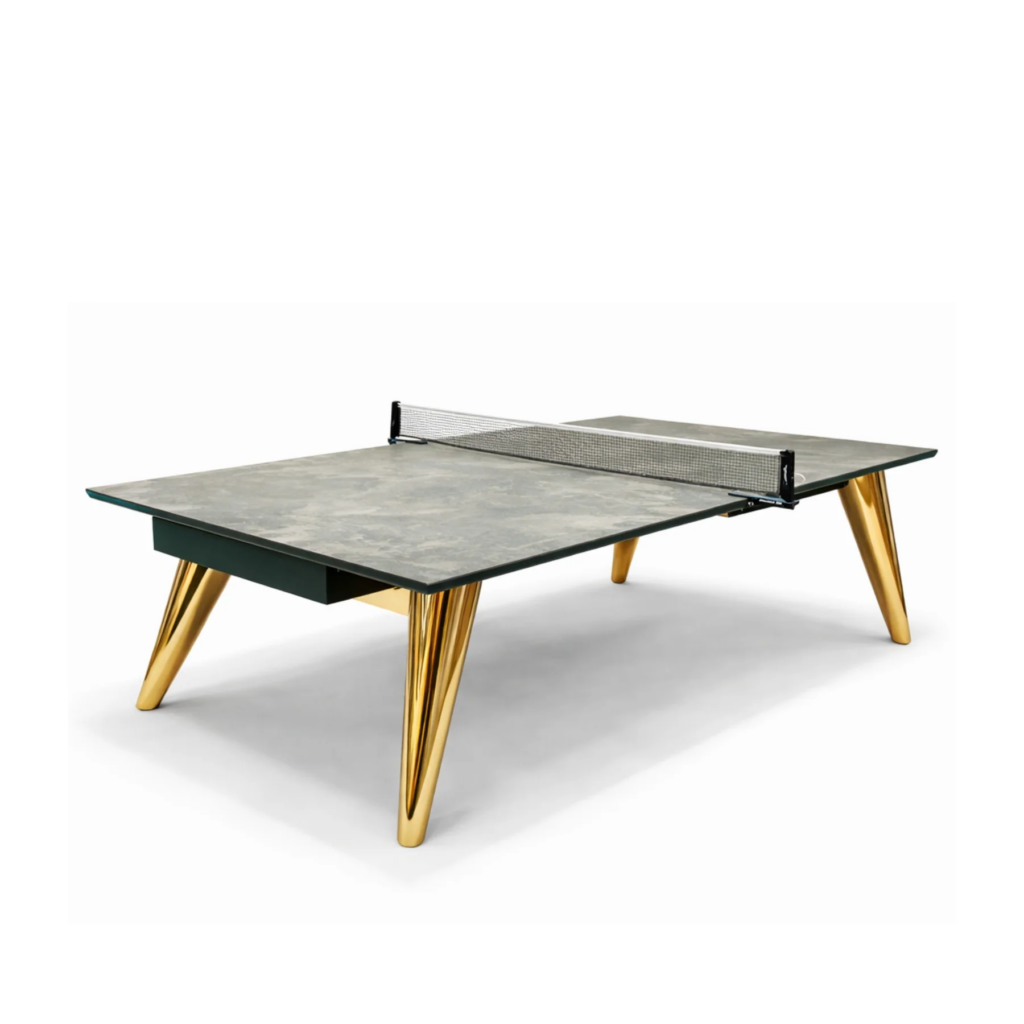
A table tennis table is a regulated sports surface defined by precise dimensions of 9 ft by 5 ft (274 cm by 152.5 cm), a uniform height of 30 in (76 cm), and a controlled rebound profile governed by surface thickness and coating behavior. Competitive-grade tables typically use a 18 mm to 25 mm top, producing a rebound where a standard ball dropped from 12 in (30.5 cm) rises close to 9 in (23 cm) under regulated conditions. Frames are commonly steel-supported with cross-bracing, and total weight generally falls between 150 lb and 300 lb (68 kg to 136 kg), depending on construction approach and intended use.
Selecting the right table involves evaluating structural composition, surface engineering, joinery logic, and spatial intent, whether recreational or aligned with International Table Tennis Federation dimensional frameworks. Indoor tables prioritize surface precision and coating uniformity, while outdoor variants incorporate composite skins designed for environmental resistance. For those considering ARGMAC table tennis tables, the decision ultimately rests on how each internal component contributes to long-term stability, bounce integrity, and architectural integration.
Surface Core Architecture and Layer Composition
Table of Contents
The playing surface in luxury tables is not a single slab but a layered system engineered for consistency. At the core lies an engineered wood panel, typically high-density fiberboard or multi-layer composite, selected for uniform internal grain distribution. This uniformity ensures that ball response does not vary across different zones of the table.
Above the core sits a calibrated coating stack, often consisting of primer, pigment, and protective seal layers. Each layer contributes to friction control, visual uniformity, and durability. The total build-up must remain within tight thickness tolerances to avoid altering bounce response while still protecting the surface from micro-abrasions over extended use.
Subframe Engineering and Structural Reinforcement
Beneath the surface, the subframe defines how load is distributed across the table. Luxury tables typically employ reinforced steel or hybrid wood-metal frameworks that maintain rigidity without excessive weight concentration. The geometry of this subframe determines whether the table resists flex under dynamic impact.
Cross members are positioned strategically to support high-impact zones, particularly along the centerline and edges. These reinforcements prevent long-term sagging, ensuring that the surface remains planar within strict tolerances even after repeated use.
Edge Profiling and Impact Protection
Edge construction plays a dual role, protecting the surface while contributing to the table’s visual identity. High-end tables use solid wood or composite edge banding, typically ranging between 2 mm and 5 mm in thickness, bonded using precision adhesives that prevent separation over time.
This edge layer absorbs incidental impacts, reducing the risk of chipping or delamination. In luxury builds, edge profiling is often flush-finished or slightly beveled, maintaining a seamless transition between surface and frame while preserving structural integrity.
Coating Systems and Friction Calibration
Surface coatings are engineered to achieve a precise balance between grip and glide. Friction coefficients must remain stable across the entire surface to ensure predictable spin behavior. Variations in coating thickness or composition can lead to inconsistent ball response, particularly in high-speed rallies.
Advanced coating systems are designed to resist UV degradation and surface wear, maintaining their friction profile over time. Matte finishes reduce glare while preserving visibility under controlled lighting conditions typically used in indoor play environments.
Base Frame Geometry and Load Path Design
The base frame supports the entire structure and determines how forces travel through the table during play. Luxury tables often use rectangular or square-section steel tubing arranged in geometries that maximize rigidity while minimizing visual bulk.
Load paths are engineered to distribute force evenly from the surface to the ground. This prevents localized stress accumulation, which could otherwise lead to structural fatigue. The connection between frame and surface is carefully calibrated to avoid vibration transfer that might affect gameplay.
Joinery Techniques and Assembly Precision
Joinery methods in luxury tables extend beyond simple bolting. Precision-engineered joints, concealed fasteners, and reinforced brackets ensure alignment accuracy and long-term stability. These methods allow repeated assembly without degradation of structural integrity.
Vibration Dampening and Acoustic Response
Material selection influences how the table responds acoustically to ball impact. Denser cores produce sharper, more consistent sound signatures, indicating uniform internal structure. Some designs incorporate dampening layers to reduce unwanted resonance.
Weight Distribution and Center of Gravity
Weight is treated as a controlled variable. Tables exceeding 250 lb (113 kg) tend to exhibit improved stability due to a lower center of gravity. Proper distribution ensures that the table remains grounded during aggressive play scenarios.
Modular Construction and Transport Logic
Luxury tables often adopt modular construction systems. Sections are designed for transport without compromising alignment accuracy during installation. Each module integrates seamlessly, preserving surface continuity across joints.
Spatial Integration and Architectural Intent
Luxury table tennis tables are designed as architectural objects rather than standalone equipment. Their proportions, materials, and finishes are selected to complement interior environments, whether residential, corporate, or hospitality settings.
Integration requires careful spatial planning. Clearance zones, lighting distribution, and flooring materials all influence how the table functions within its environment. The table must coexist with surrounding elements without disrupting movement flow or visual balance.
- Minimum clearance: approximately 5 ft (152 cm) per side
- Ceiling height: at least 9 ft (274 cm)
- Lighting range: 300 to 500 lux
- Floor tolerance: within 3 mm
Convertible Systems and Dual-Function Engineering
One defining characteristic of luxury tables is their ability to transform into functional furniture. Convertible systems allow the table to serve as dining or conference surfaces, integrating seamlessly into multi-use environments. Unlike standard foldable designs, these systems operate within strict dimensional tolerances so that the primary playing surface of 274 cm by 152.5 cm (9 ft by 5 ft) remains uncompromised even after repeated conversions.
These systems rely on removable components and concealed locking mechanisms engineered to handle distributed loads exceeding 200 lb to 400 lb (90 kg to 180 kg), which aligns with the weight class of tournament-grade tables. Structural engineering ensures that load-bearing capacity remains consistent in both configurations, with deflection typically maintained under 3 mm across the span to prevent surface distortion.
Precision hinges and modular tops are calibrated to maintain alignment accuracy within millimetric tolerances, ensuring that the seam between convertible panels does not interfere with ball trajectory. The approach of blending performance with spatial utility and design intent, where transformation does not dilute playability but preserves it through engineered continuity.
Craftsmanship Layers and Material Hierarchy
Luxury tables are defined not just by materials but by how those materials are layered and finished. Hardwood frames, veneers, and specialty finishes such as PU coatings contribute to both durability and visual refinement. The internal hierarchy begins with the core surface, typically 22 mm to 25 mm thick in high-performance builds, which provides the optimal balance between weight and rebound consistency.
Material hierarchy determines performance hierarchy. The surface dictates playability, the frame dictates stability, and the finish dictates longevity. Tournament-grade tables often weigh between 250 lb and 400 lb (113 kg to 180 kg), reinforcing the role of mass in stabilizing the structure during play.
High-end builds may incorporate layered veneers, leather detailing, or composite reinforcements, each contributing to both tactile experience and structural behavior. The sequencing of these materials is critical, as improper layering can introduce inconsistencies in density, directly affecting bounce uniformity and acoustic response.
Precision Manufacturing and Tolerance Control
Manufacturing precision is critical in maintaining performance consistency. Surface flatness must remain within extremely tight tolerances, often within ±2 mm across the entire 274 cm length, to ensure uniform ball response. Even minor deviations can alter bounce trajectory, particularly in high-speed rallies where spin and angle interactions are amplified.
CNC machining and controlled finishing processes are employed to achieve this level of accuracy. Surface coatings are applied in calibrated layers to maintain gloss levels typically below 6 units, reducing glare while preserving friction consistency.
Tolerance control extends to every joint and interface. Bounce uniformity across the surface is expected to remain within a 5 mm variation range under regulated testing conditions, ensuring that no section of the table produces inconsistent response.
Final Thoughts
What defines a table tennis table that operates as both a precision instrument and a spatial centerpiece? The answer lies in how every layer, joint, and material decision contributes to a unified system that performs consistently while integrating seamlessly into its environment. For those evaluating ARGMAC’s luxury TT range, the focus shifts from surface-level features to understanding the complete anatomy behind performance and longevity. Within this framework, ARGMAC approaches table tennis through engineered craftsmanship and material discipline, where hardwood structures, reinforced frames, and refined playing surfaces function as a cohesive system balancing durability with visual precision.
“A table tennis table should not interrupt a space. It should belong to it, structurally and visually, with materials that respond the same way over years as they do on day one,” notes Akshay Choudhary. This alignment between engineering accuracy and architectural intent defines long-term usability, ensuring the table remains performance-consistent and contextually relevant. For those seeking both precision play and design continuity, ARGMAC’s range offers a solution that integrates seamlessly into refined spaces.

