
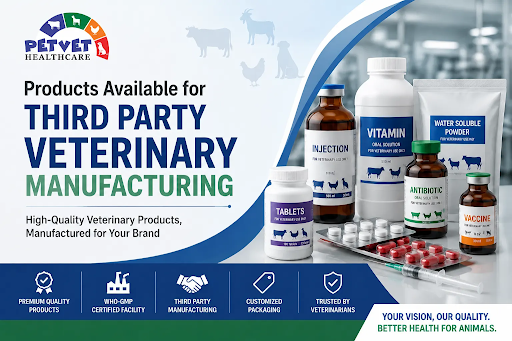
Working with a third party veterinary medicine manufacturer in India usually follows seven stages: enquiry, product selection, quotation, artwork approval, production, quality release and dispatch. You will need business and licence documents, and your total cost depends on formulations, batch size and packaging. Careful planning at the start prevents delays later.
Why India Is a Strong Base for Contract Veterinary Manufacturing
Table of Contents
India has a well-developed pharmaceutical ecosystem, access to raw materials, experienced technical staff and competitive production costs. Combine that with a large livestock and poultry population and a growing pet segment, and the country offers both manufacturing capacity and a big domestic market.
According to MRFR (2025), India’s veterinary medicine manufacturing market is growing at about 8.8% a year and may reach around USD 2.25 billion by 2034. For new brands, contract manufacturing offers a practical way to enter this space.
Who Uses Third Party Veterinary Manufacturing?
The model works for a wide range of businesses:
- New entrepreneurs building an animal health brand
- Distributors who want private-label products
- Veterinarians expanding into product lines
- Established human-pharma firms starting a veterinary division
- Exporters sourcing branded products for overseas markets
The Seven-Stage Process
Stage 1: Enquiry and requirement discussion
You share the products you need, target species, expected volumes and markets. A good manufacturer asks questions about your goals rather than sending a generic price list.
Stage 2: Product and formulation selection
You choose from available formulations such as injections, boluses and feed supplements, or discuss variations. Confirm composition, strength, pack size and shelf life for each item.
Stage 3: Quotation and commercial terms
Request a written quotation covering unit price, minimum order quantity, packaging cost, taxes, payment terms and delivery time.
Stage 4: Artwork and label approval
You provide brand name, logo, design and marketing claims. The manufacturer reviews regulatory information such as composition, batch number, dates, licence details and storage instructions. Approve the final proof carefully, because printing errors are expensive.
Stage 5: Production
The manufacturer sources raw materials, produces the batch and performs in-process checks.
Stage 6: Quality release
Finished products are tested against specifications before release, and batch records are maintained.
Stage 7: Dispatch and after-sales support
Products are packed, invoiced and shipped. You then plan reorders, launches and promotions.
Documents You May Need
Requirements vary by state and product type, but commonly include:
- Business registration proof
- GST registration
- PAN and identity details
- Address proof of your office or firm
- Trademark application or registration for your brand name, which is strongly recommended
- Any licence needed for wholesale or retail of medicines, depending on your business model
Ask the manufacturer for a checklist and confirm requirements with your local drug authority.
Understanding the Cost Structure
| Cost component | Notes |
| Manufacturing cost per unit | Depends on formulation and raw materials |
| Packaging | Bottles, vials, cartons, labels, printing |
| Artwork and design | One-time design and proofing costs |
| Minimum order quantity | Affects first-order investment |
| Transport | Depends on distance and quantity |
| Taxes | Applicable GST and other statutory charges |
| Trademark and compliance | Registration and legal fees |
Rather than chasing the lowest per-unit price, compare the total landed cost and the quality you receive for it.
How to Evaluate a Third Party Manufacturer in India
Check the facility. Ask for licence and certification copies, and if possible visit the plant or request a virtual walkthrough.
Ask about testing. A capable manufacturer can explain how raw materials, in-process samples and finished batches are checked.
Review samples. Examine sample packs for label clarity, seal quality and consistency.
Assess responsiveness. How quickly and clearly the team answers your questions before you sign is a good predictor of future service.
Start small. A trial order reveals real-world quality, delivery discipline and communication.
Common Mistakes First-Time Brand Owners Make
- Launching too many products at once. Start with a focused range and expand later.
- Ignoring trademark protection. Register your brand name early.
- Approving labels without full review. Double-check every line.
- Skipping marketing planning. Manufacturing is only half of the business; you still need to promote and distribute.
- Not planning cash flow. Production, inventory and credit terms tie up working capital.
Petvet Healthcare’s Contract Manufacturing
Petvet Healthcare is based in Ambala Cantt, Haryana, and states that it follows WHO-GMP and cGMP norms. Its third party and contract manufacturing service supports businesses that want their own veterinary brand, with modern packaging and quality raw materials.
To get started, explore the product list, check packaging styles in the product gallery, and use the contact page to share your requirements. If you prefer a lower-investment route, see the PCD franchise option.
Planning Your Launch
Once your first batch is ready, consider these steps:
- Introduce the range to local veterinarians and provide product information.
- Build a distributor or dealer network in your target region.
- Track feedback and adjust your range accordingly.
- Follow storage and handling guidelines to keep products in good condition.
- Encourage responsible use by directing customers to registered veterinarians for diagnosis and dosage.
Conclusion
The process of working with a third party veterinary medicine manufacturer in India becomes straightforward when you understand each stage, prepare documents early and choose a partner with transparent practices. Compare quotations, verify credentials and begin with a manageable range. For a discussion about your brand, contact Petvet Healthcare.
Frequently Asked Questions
How long does third party manufacturing take?
Timelines depend on formulation, artwork approval and batch size. Ask for a written timeline with your quotation.
Can I use my own brand name?
Yes, that is the main advantage of contract manufacturing, though the label must meet regulatory requirements.
Is there a minimum order quantity?
Most manufacturers set one. Ask about flexibility for first orders.
Do I need a licence to sell?
Selling medicines usually requires an appropriate licence from your state authority. Check requirements for your business type.

